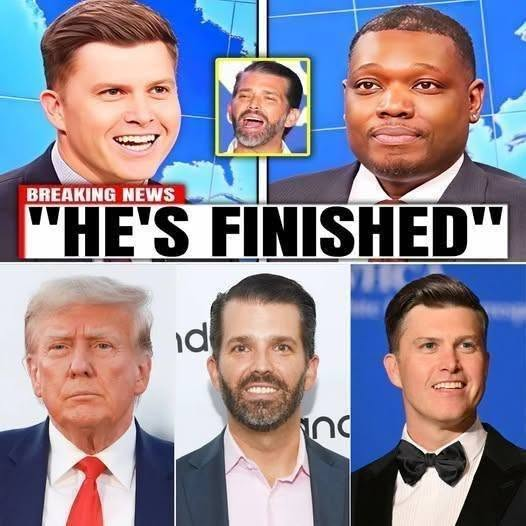
When Comedy Becomes a Political Battlefield
For decades, Saturday Night Live has used comedy to challenge politicians, celebrities, and powerful public figures. Donald Trump has been one of its most recognizable targets, with comedians repeatedly portraying his personality, public statements, and political controversies.
The show’s willingness to make jokes about powerful figures has sometimes created serious disagreements beyond the television studio.
For the Trump family, the jokes have often become a source of public criticism and online arguments.
Don Jr. and the Growing Tension
Donald Trump Jr. has established himself as a prominent political commentator and public defender of his father’s administration.
Like his father, he has frequently participated in political debates on social media and television.
The fictional scenario behind this headline imagines Don Jr. becoming increasingly frustrated after an SNL segment turns its attention toward him and his father.
But there is a larger question worth considering: should political figures be able to influence what comedians are allowed to say about them?
SNL Has Never Been Afraid of Political Controversy
Saturday Night Live has built much of its identity around political impressions and controversial comedy.
Over the years, performers have portrayed presidents, presidential candidates, politicians, and other influential personalities.
Donald Trump himself even hosted the programme in 2004 and again in 2015, before becoming president.
His relationship with the show later became considerably more hostile as its comedians continued producing jokes about him.
Trump’s Long-Running Disagreement With Late-Night Television
Donald Trump has repeatedly criticized television comedians who make him the subject of their jokes.
His public disagreements with Jimmy Kimmel, Stephen Colbert, and other late-night personalities have become part of a broader national discussion about political influence and freedom of expression.
In September 2025, SNL even made Trump’s criticism of late-night television the subject of its season premiere satire.
The sketch featured James Austin Johnson portraying Trump and joking about the possibility of the programme facing consequences for making fun of him. <Cite refs={[“turn741030search1″,”turn741030news11”]}/>
The Bigger Question: Can Political Power Silence Comedy?
At the heart of this controversy is a question that extends beyond the Trump family.
Should comedians be free to criticize presidents and their families without fear of political retaliation?
Comedy has historically played an important role in democratic societies by questioning authority and exposing contradictions in public life.
Politicians are entitled to criticize comedians, just as comedians are entitled to criticize politicians.
The real challenge is protecting that freedom while allowing audiences to decide what they find funny, offensive, or unfair.