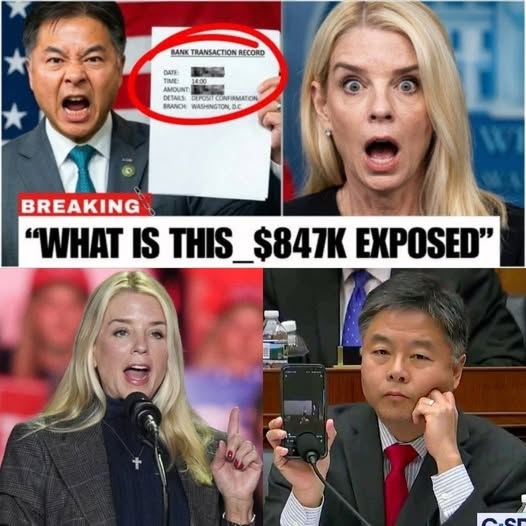
THE $847,000 EPSTEIN BANK RECEIPT CLAIM PUTS PAM BONDI AND TED LIEU BACK IN THE SPOTLIGHT — But What Really Happened During Their Congressional Confrontation?
 OPENING PARAGRAPH 1 — THE ALLEGED RECEIPT THAT SPARKED QUESTIONS
 WASHINGTON, D.C.
— A SINGLE BANK RECEIPT, AN ALLEGED $847,000 TRANSFER, AND A FORMER ATTORNEY GENERAL SUPPOSEDLY FORCED INTO SILENCE: THE LATEST STORY CIRCULATING ONLINE SOUNDS LIKE A MOMENT THAT COULD CHANGE AN ENTIRE POLITICAL CAREER.
Advertisement
According to the viral account, Representative Ted Lieu produced a financial document during a congressional hearing that directly implicated Pam Bondi in payments connected to Jeffrey Epstein.
The story describes an exact timestamp, a series of structured transactions, and an extraordinary moment when Bondi supposedly invoked her Fifth Amendment right against self-incrimination.
But the details raise an immediate question: Where is the authenticated bank record or congressional footage supporting such a consequential allegation?
Advertisement
OPENING PARAGRAPH 2 — THE REAL CONFRONTATION WAS ALREADY CONTROVERSIAL
 THE SURPRISING PART IS THAT TED LIEU AND PAM BONDI REALLY DID HAVE A HEATED CONFRONTATION OVER THE EPSTEIN FILES — BUT THE VERIFIED RECORD TELLS A VERY DIFFERENT STORY.
During a February 11, 2026, House Judiciary Committee hearing, Lieu challenged Bondi about the Justice Department’s handling of Epstein-related evidence and questioned whether officials had adequately investigated allegations involving powerful individuals.
Advertisement
Their exchange became confrontational, and Lieu subsequently called for an independent investigation into what he described as misleading sworn testimony.
Yet the documented dispute did not involve an authenticated $847,000 wire transfer, 18 proven illegal payments, or Bondi invoking the Fifth Amendment on live television.
 READ THE FULL STORY BELOW — THE ACTUAL HEARING REVEALS IMPORTANT QUESTIONS ABOUT EVIDENCE, CONGRESSIONAL OVERSIGHT, AND WHAT THE GOVERNMENT HAS DISCLOSED.
Advertisement
The Congressional Hearing That Drew National Attention
On February 11, 2026, Attorney General Pam Bondi appeared before the House Judiciary Committee.
Lawmakers questioned her about the Justice Department’s operations, federal law enforcement priorities, and the disclosure of records related to Jeffrey Epstein.
The hearing took place amid continuing demands for transparency following the release of millions of pages of investigative materials.
Advertisement
Representative Ted Lieu, a California Democrat and former military prosecutor, used his time to press Bondi about the government’s treatment of allegations involving individuals connected to Epstein.
He specifically challenged her statements regarding President Donald Trump.
The exchange quickly became one of the hearing’s most widely discussed moments.
What Ted Lieu Actually Presented
During his questioning, Lieu referenced material from the released Epstein files and publicly available images involving Epstein and prominent individuals.
Advertisement
He also cited an FBI record containing an allegation involving Trump.
The allegation was unverified and should not be treated as proof of criminal conduct.
Bondi rejected Lieu’s suggestion that the department had evidence establishing wrongdoing by Trump.
Lieu responded by accusing her of making a false statement under oath.
Their disagreement concerned the meaning and handling of evidence, rather than the supposed financial transaction now circulating online.
No verified record of the hearing establishes that Lieu presented a bank receipt bearing Bondi’s name and documenting an $847,000 Epstein-related payment.
The $847,000 Allegation
The viral account offers unusually precise details.
It describes a transfer worth $847,000, supposedly timestamped at 11:47 p.m.
It also alleges that 18 payments were structured to evade federal financial-reporting requirements.
Those are serious accusations.
Financial structuring generally involves breaking transactions into smaller amounts for the purpose of evading applicable reporting rules.
Whether such conduct constitutes a crime depends on the circumstances, evidence, and relevant law.
But the circulating story has not provided an authenticated bank record demonstrating that Bondi received the alleged transfer.
Nor has credible independent reporting established the claimed sequence of 18 unlawful payments.
Precision does not equal proof.
A number and a timestamp can make a story appear convincing without demonstrating that the underlying transaction ever occurred.
Did Bondi Invoke the Fifth Amendment?
Another central claim is that Bondi invoked her Fifth Amendment right against self-incrimination during a televised hearing.
That moment is not supported by the verified February 11 record.
The Fifth Amendment protects individuals against being compelled to provide testimonial evidence that could incriminate themselves.
Invoking that protection is not, by itself, an admission of guilt.
But the distinction is particularly important here because Bondi did invoke a different form of privilege later in 2026.
During a closed-door House Oversight Committee interview on May 29, she declined to answer some questions about communications involving President Trump and the Epstein files.
Advertisement
She cited executive-branch privilege.
That is legally different from invoking the Fifth Amendment.
It also occurred during a closed-door proceeding, not the dramatic live-television scene described in the viral post.
What Happened After the February Hearing?
The confrontation continued beyond the committee room.
Lieu and Representative Dan Goldman subsequently called for a special counsel to investigate whether Bondi had committed perjury.
They argued that her sworn statements should be evaluated against information contained in the Epstein records.
Their request represented a formal political and legal challenge.
It did not establish that she had committed perjury.
Proving that offense requires evidence satisfying specific legal standards, including whether a materially false statement was knowingly made under oath.
The Justice Department’s account and the underlying evidence would have to be evaluated before any legal conclusion could be reached.
Bondi’s Departure and Later Testimony
Bondi was removed as attorney general in April 2026.
Her departure did not end congressional scrutiny of how the Epstein records had been handled.
The House Oversight Committee continued seeking testimony and documents about the disclosure process.
On May 29, Bondi participated in a closed-door interview with lawmakers.
She defended aspects of the department’s work while declining to answer certain questions about internal executive-branch communications.
The proceedings attracted attention because lawmakers from both parties had raised concerns about whether all legally required records had been disclosed.
These documented events are significant without adding an unsupported financial scandal.
Why Financial Evidence Requires Verification
Authentic financial evidence can be extremely important in a criminal investigation.
Bank records may establish payment dates, transaction amounts, account ownership, and relationships between parties.
However, even a genuine transfer does not automatically prove illegal conduct.
Investigators would need to establish the purpose of the payment, the identity of the sender and recipient, and the circumstances surrounding the transaction.
A document’s origin, authenticity, and chain of custody are also essential.
In the absence of those elements, the alleged $847,000 receipt cannot responsibly be described as a financial smoking gun.
The Larger Epstein Transparency Debate
The controversy surrounding Epstein’s files has involved disagreements about redactions, investigative decisions, survivor protections, and public access.
Lawmakers have sought more information about how federal authorities handled the case.
The Justice Department has defended parts of its disclosure process while citing privacy and legal restrictions.
For survivors, accountability requires more than identifying influential individuals.
It requires careful investigation, credible evidence, and appropriate protection from further harm.
The Question That Remains
The verified confrontation between Ted Lieu and Pam Bondi raises legitimate questions about government accountability.
But the allegation of an $847,000 transfer, 18 illegal payments, and a dramatic Fifth Amendment declaration remains unsupported.
Those details should not be presented as established facts.
THE MOST IMPORTANT QUESTION IS NOT WHETHER A VIRAL BANK RECEIPT HAS ALREADY PROVEN A POLITICAL SCANDAL — IT IS WHETHER THE DOCUMENTS AND TESTIMONY THAT ACTUALLY EXIST CAN HELP ESTABLISH WHAT FEDERAL OFFICIALS KNEW, DISCLOSED, AND INVESTIGATED.
When allegations concern serious criminal conduct, authentic evidence matters more than dramatic descriptions.